
MULTI-FRONT STRUGGLE WITHOUT A PROGRAMME IS DRIFT: A CRITIQUE OF INSTITUTIONAL “INFLUENCE” BY MANQOBA NXUMALO
I read with interest an article published by Swazi Bridge where Manqoba Nxumalo argues that real political change in eSwatini requires struggle from both outside and inside state institutions. I figured I must offer a rejoinder not so much to engage in ideological gymnastics but to enrich and elevate the debate. The last time I had a healthy exchange on the battle of ideas the subsequent commentary degenerated an otherwise necessary conversation. I hope this time it is different.
In his article Manqoba criticises what he describes as purist hostility toward institutional engagement and to a certain extent defends the participation of activists in boards, regulatory bodies, and even elections as necessary forms of influence. While this intervention correctly rejects moralism and political self-isolation, it ultimately flirts with a misunderstanding of power and a dangerous neglect of programme, organisation, and cadre discipline.
From my perspective, the question is not whether struggle must be waged on multiple fronts. That principle is well established. No institution of the ruling order is neutral, and no terrain should be left uncontested. The real question is how those fronts are engaged, by whom, and under what strategic authority. On these decisive matters, Nxumalo’s argument is silent and that silence in my view, is politically consequential.
Nxumalo treats multi-front struggle as a matter of political attitude: openness versus rigidity, realism versus purism. In doing so, he reduces a question of revolutionary organisation to one of temperament. This obscures the real source of the confusion and hostility he describes. I believe the problem is not intolerance among activists; it is the absence of a clear revolutionary programme capable of assigning tasks, defining roles, and judging tactics collectively.
Where no programme exists, participation appears arbitrary. Individuals enter institutions without mandate, without prior allocation of responsibility, and without clear lines of accountability. The movement is then expected to retrospectively interpret these actions as “tactical positioning.”
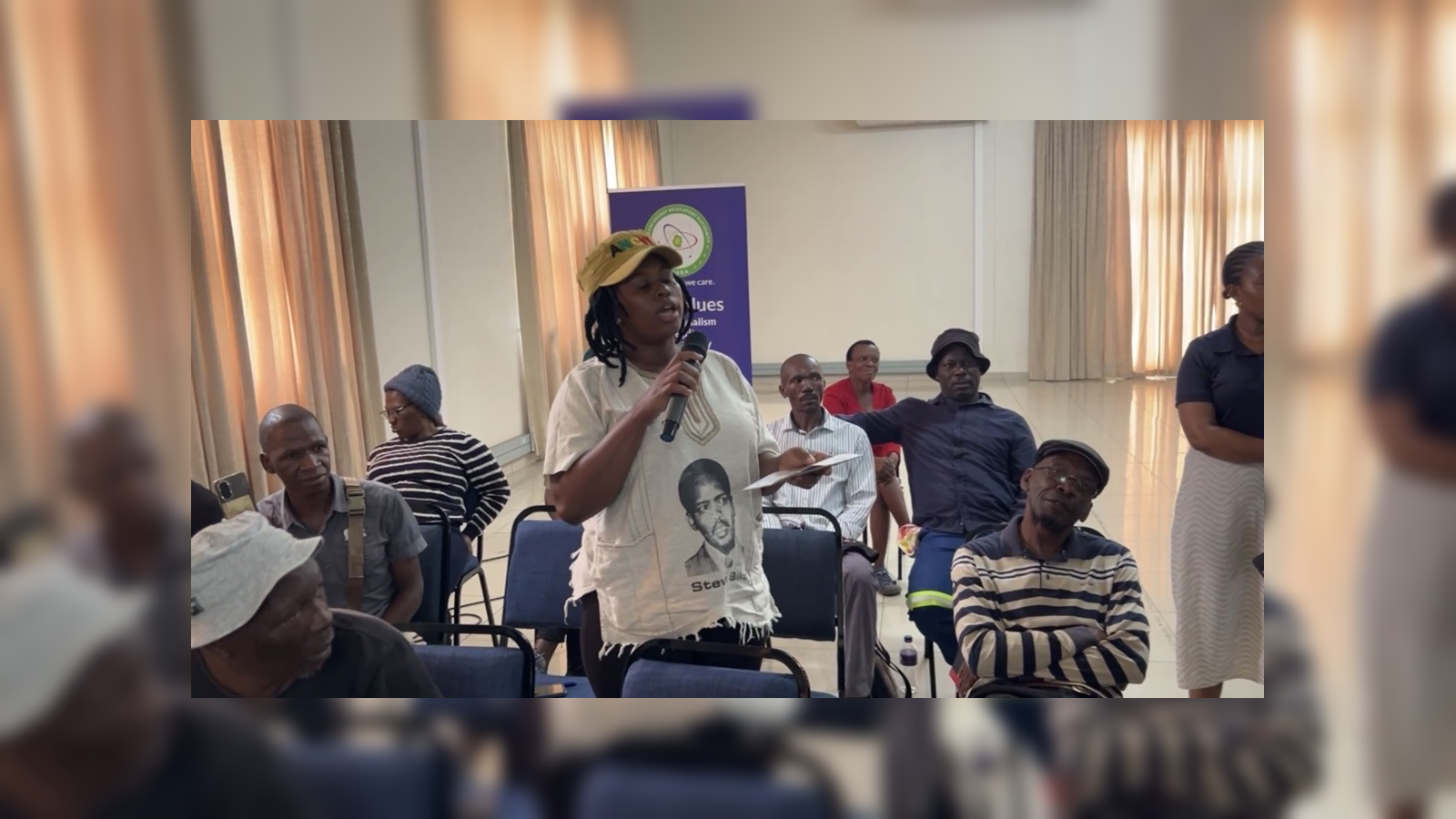
 Consumer Forum member and PUDEMO activist Mphandlana Shongwe
Under such conditions, accusations of betrayal are not aberrations — they are the inevitable product of spontaneity masquerading as strategy. We must never equate multi-front struggle with indiscriminate participation. Lenin was explicit: revolutionary politics requires division of labour, specialisation, and discipline. Not everyone fights on every front. Above-ground political leadership, mass mobilisation, agitation, propaganda, and underground operational work are distinct functions carried out by different cadres under unified strategic direction.
It is precisely this distinction that Nxumalo collapses. By celebrating the entry of visible, above-ground activists into regime-appointed boards and auxiliary institutions, he confuses infiltration with assimilation. There is no revolutionary logic that requires senior, publicly known cadres of organisations like PUDEMO or its youth formations to contest Tinkhundla elections or occupy state structures. On the contrary, this practice undermines both political clarity and organisational security.
It is also necessary to make an important distinction that Nxumalo gestures toward but does not adequately illuminate. It is politically incoherent to treat all appointments into statutory bodies as equivalent. There is a substantive difference between a trade union leader serving on a board: an arrangement broadly consistent with international labour standards and social-dialogue frameworks—and the appointment of an overt leader of a banned revolutionary organisation such as PUDEMO into a regime structure.
Trade unions, even under capitalism, are recognised interlocutors within the industrial relations system; revolutionary political organisations are not. To collapse this distinction is to obscure the specific political risks involved and to mischaracterise legitimate union participation as betrayal, while simultaneously normalising the far more dangerous blurring of lines between outlawed political leadership and the institutions of an authoritarian regime.
The appointment of the current TUCOSWA SG or ATUSWA SG into some boards of the regime can never and must never be equated to the appointment of the SWAYOCO TG into one of the boards. Whether the latter is deployed by SNUS (Swaziland National Unio of Student) or SWACOF (Swaziland Consumer´s Forum). The article deals will the duality roles crisis.
In a serious revolutionary movement, engagement with hostile institutions is not carried out by recognisable leaders whose presence legitimises those institutions. It is carried out by trained cadres, grounded in theory and praxis, deployed for specific tasks, and kept operationally separate from overt leadership. Their role is not to “humanise power” or soften attitudes, but to expose contradictions, disrupt consensus, and advance the strategic interests of the masses.
 SWAYOCO Treasure Nontsikelelo Nkambule
When infiltration is done correctly, the institution is destabilised; when done poorly, the cadre is absorbed. Nxumalo’s argument also fails to confront the problem of dual roles. Activists increasingly find themselves serving simultaneously in overt revolutionary structures and in regime institutions through deployments by auxiliaries. This duality muddies political lines, weakens accountability, and confuses the masses.
It becomes unclear whether an institution is being opposed, infiltrated, or legitimised and by whom. One must warn against such ambiguity. One cannot serve the revolution and administer the institutions of domination without clear organisational separation and strict political discipline.
Nxumalo’s argument does not appear as an explicit ideological defence of the system. Rather, it emerges as a practical orientation that mistakes access for power and participation for influence. History teaches otherwise. Ruling classes routinely absorb selected critics not because they are being pressured, but because co-option is an effective method of neutralising opposition and managing dissent. None of this implies that institutions should be ignored or abandoned.
The error lies not in engagement, but in unstructured engagement. Without a programme, infiltration becomes opportunism. Without trained cadres, participation becomes personal advancement. Without organisational clarity, multi-front struggle degenerates into confusion and mistrust. The way forward is not the moral condemnation of those who enter institutions, nor the romanticisation of institutional access as progress.
It is the construction of a disciplined revolutionary movement with a clear programme, sufficient human resources, and a conscious division of labour. Above-ground cadres must focus on mass mobilisation and political education. Underground cadres must be prepared for infiltration and disruption. Organs of people’s power within the Mass Democratic Movement must be developed as alternatives to the regime’s structures, not extensions of them.
Until this organisational question is resolved, debates about “inside” and “outside” struggle will remain superficial. Every appointment will provoke suspicion, every critique will sound sectarian, and every intervention will appear improvised. The problem is not excessive radicalism. It is the absence of revolutionary preparation. Multi-front struggle is not a slogan. It is a method — and without programme, discipline, and cadre clarity, it becomes not a path to victory, but a mechanism for drift.